
Turns per day is the single number that decides whether a winder keeps your watch running or lets it stop. It is the count of complete rotations the cradle performs in a 24 hour period, spread across short bursts with long rests between them. Direction is the other half of the setting: clockwise, counter-clockwise, or alternating between the two. Get both roughly right and the watch stays wound. This guide gives the figures most commonly published for the major brands, then explains why the calibre inside your watch matters more than the name on the dial.
What Does TPD Actually Mean?
An automatic watch winds itself through a weighted rotor that swings as your wrist moves. That motion tensions the mainspring, which stores the power that drives the watch. A winder replaces your wrist with a motor, and TPD describes how much motion it supplies.
The important part is that a winder does not spin continuously to reach its TPD figure. A unit set to 750 TPD might turn for two minutes, rest for six, and repeat — over 24 hours those bursts add up to 750 rotations. That resting is deliberate. It gives the movement long periods at rest, exactly as it would get if the watch were on a wrist overnight, and it keeps unnecessary running hours off the mechanism.
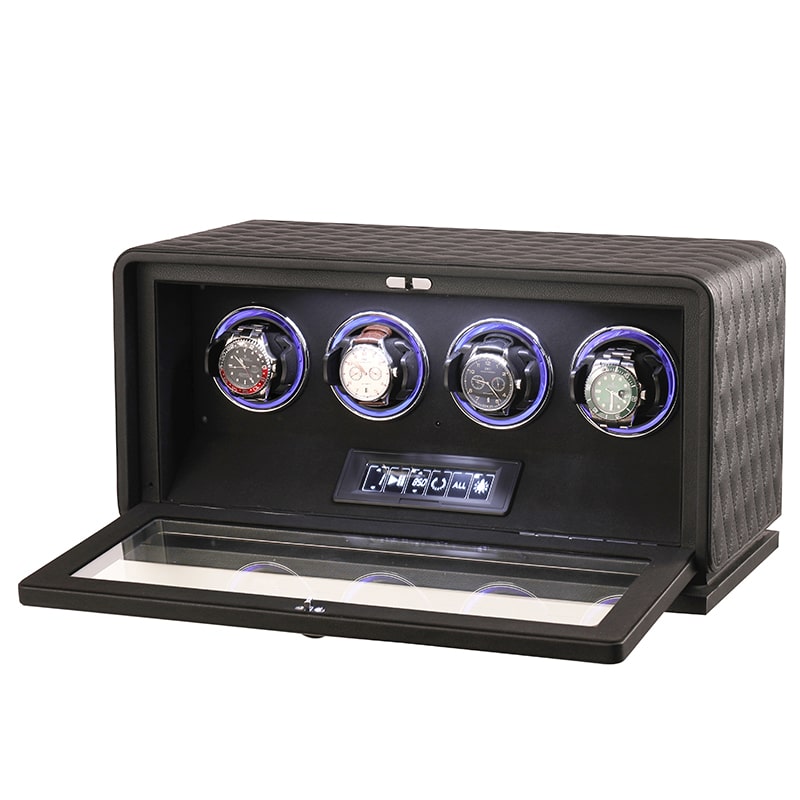
You will see winders express this in different ways. Some quote a TPD number directly. Others describe a mode, such as “rotates clockwise for two minutes, stops for six minutes, cycle”, which is the same thing said in plain language. Westhill’s Single Automatic Watch Winder uses that second style, while the 4 Slot CronoGuard Watch Winder exposes rotation speed and direction on a touchscreen.
What Does Rotation Direction Do?
Inside the movement, the rotor is connected to the winding gear through a mechanism that may engage in one direction only, or in both. A unidirectional movement takes energy from the rotor swinging one way and freewheels the other. A bidirectional movement takes energy both ways.
If your watch winds in one direction only and the winder is turning the wrong way, the watch simply does not wind. That is the practical reason direction matters. The safe general answer is alternating: the winder turns one way, then the other, so a unidirectional movement gets winding on half the cycles and a bidirectional movement gets it on all of them. Every Westhill winder offers clockwise, counter-clockwise and alternating modes, so you are not forced into a guess.
Typical TPD and Direction by Brand
The figures below are the ones most commonly published by watch winder manufacturers and specialist retailers for mainstream modern calibres. Treat them as starting points, not specifications from the manufacturers themselves.
| Brand | Commonly published TPD | Commonly published direction |
|---|---|---|
| Rolex | around 650 | Bidirectional (alternating) |
| Tudor | around 650 | Bidirectional (alternating) |
| Omega | 650 to 800 | Bidirectional (alternating) |
| Breitling | 650 to 800 | Bidirectional (alternating) |
| Seiko | 650 to 800 | Bidirectional (alternating) |
The pattern is hard to miss. Almost every mainstream modern automatic sits in the same broad band and winds in both directions, which is why a winder set to alternating at roughly 750 TPD will keep the great majority of collections running. The brands differ far less than the marketing around winders suggests.
Why You Should Check Your Calibre, Not Your Brand
A brand is not a movement. Rolex, Omega, Breitling and Tudor have all used several generations of calibre, and some have used outside movements at various points in their history. Two watches with the same name on the dial, made twenty years apart, can want different settings.
Finding your calibre is usually straightforward. It is printed in the warranty booklet or the manual that came with the watch, listed on the manufacturer’s product page under specifications, and often engraved on the movement itself. Once you have the calibre number, the maker’s own documentation or your authorised service centre is the authority on winding requirements. That is a five minute job that removes all the guesswork, and it is worth doing once rather than wondering every time you change a setting.
Vintage watches deserve a little more caution. An older movement that has not been serviced recently is best looked at by a watchmaker before it goes on a winder, and a very old or worn mechanism is often happier being wound by hand and left to run down.
How to Set a Winder in Practice
Start by winding the watch by hand, or wearing it for a day, so it begins fully wound. Placing a dead watch on a winder and expecting the winder to bring it back to life from nothing is the most common source of “my winder isn’t working” complaints — a winder maintains tension, it is slow at building it from zero.
Set the direction to alternating and the TPD to the middle of your watch’s published range. Leave it for two days, then check the time against a reliable reference. If the watch has kept running and is close to correct, the setting is right. If it has lost significant time or stopped, step the TPD up one increment. If your winder lets you program each slot independently — as the multi-slot Premium Watch Winders and every Westhill watch safe do — do this once per watch rather than setting the whole bank to one figure.
One last practical note: seat the watch properly on the cushion. A bracelet that is too loose lets the watch shift as the cradle turns, and a cushion that is too large stretches a leather strap. Telescopic cushions, which several Westhill winders use, let you adjust the fit rather than forcing the watch onto a fixed pillow.
What Happens If You Set It Too High or Too Low?
Too low is the common mistake and the harmless one. The watch does not receive enough motion, the mainspring gradually runs down, and one morning the watch has stopped. Nothing is damaged; you simply raise the setting.
Too high is less common and still not the disaster people fear. An automatic movement has a slipping clutch that prevents the mainspring from being tensioned beyond full, so a winder cannot overwind a healthy watch. What excessive TPD does is add running hours to the movement over a year, which brings the next service forward slightly. The sensible approach is the same as with a car: run it in the middle of its range rather than the top. Our guide on whether automatic watches need a winder covers the mechanics of that clutch in more detail.
Frequently Asked Questions
What TPD setting does a Rolex need on a watch winder?
Rolex calibres are most commonly published at around 650 turns per day with bidirectional, or alternating, rotation. That figure is a widely used starting point rather than a Rolex specification, so confirm it against the documentation for your specific calibre or ask your authorised service centre.
What is a safe default TPD if I do not know my watch’s setting?
Alternating direction at roughly 750 turns per day suits the great majority of modern automatics. It sits in the middle of the common 650 to 900 band, and alternating means the watch winds whether its movement is unidirectional or bidirectional. Check the time after two days and adjust if it has lost significant time.
Should a watch winder turn clockwise or counter-clockwise?
Alternating is the safest choice unless you know your movement winds in one direction only. A unidirectional movement still winds on the half of the cycle that turns the right way, and a bidirectional movement winds on all of it. Every Westhill winder offers clockwise, counter-clockwise and alternating modes.
Can I set different watches to different settings on one winder?
On a well-built multi-slot winder, yes. Each slot should be individually programmable for turns per day and direction. This is worth checking before you buy, because cheaper multi-slot units often drive every position from a single fixed setting.
Do Seiko automatics need a winder set differently to a Swiss watch?
Not meaningfully. Seiko automatics are commonly published in the same 650 to 800 turns per day band as most Swiss calibres, with bidirectional winding. The differences between brands are much smaller than the winder marketing suggests, which is why one mid-range setting covers most collections.
