
Almost everyone buys their first watch box one size too small. It is an easy thing to do: you count what is on the dresser this morning, find a box with exactly that many slots, and eighteen months later two watches are living in their original packaging because there is nowhere to put them. Choosing a size is a five minute job if you go about it in the right order, and the order is not “how many watches do I have”. This guide walks through the count, the sizes that suit real collections, and the dimension that catches more people out than any other.
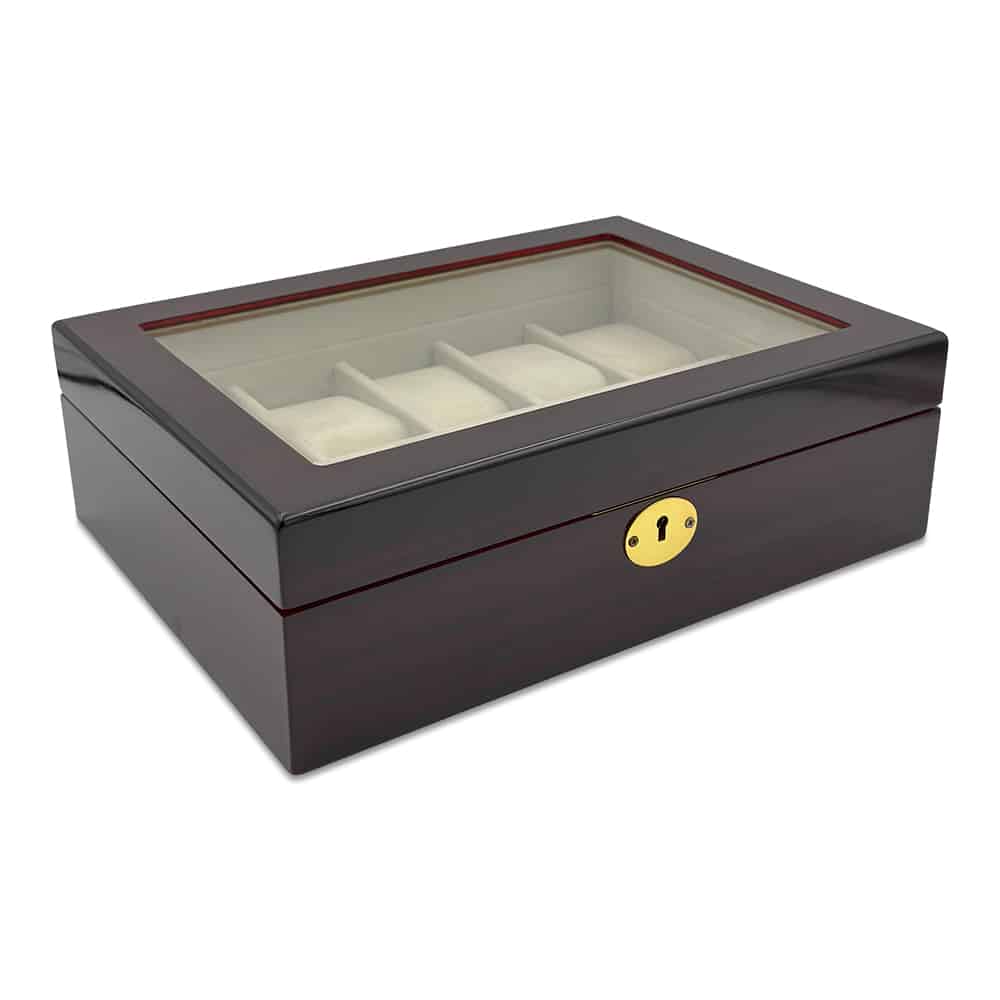
Count Honestly, Then Add Headroom
Start with a real count rather than a remembered one. Open every drawer and every travel bag, and include the watches you never wear: the one inherited from a grandparent, the quartz dress watch worn twice a year, the smart watch that lives on its charger. They all take a slot, because the point of a box is that everything has a home.
Then add headroom. A watch box is a five to ten year purchase and a collection is not static, so the sensible allowance is the number of watches you have bought in the last three years, added on top of the current count. Somebody who owns four and has bought two in three years should be looking at six or eight slots, not four.
There is a second reason to leave room. A box packed to capacity is a box you have to unpack to get anything out of, and a cushion under tension is a cushion pressing against the lining of the watch next to it. Two or three empty slots is not waste, it is the difference between a box you use daily and one you stop opening.
What Each Size Actually Suits
The table below is the pattern we see across the range. Treat it as a starting point and then apply the headroom rule above.
| Slots | Who it suits | Example from our range |
|---|---|---|
| 1 to 2 | One good watch that deserves better than a drawer, or a gift | 2 Slot Brushed Walnut Watch Box |
| 3 to 4 | A settled collection: a dress watch, a daily watch, a sports watch | 4-Slot Walnut Watch Box |
| 5 to 6 | The most common landing point, and the safest first buy | Maple Mahogany 6 Slot Watch Box |
| 8 to 12 | A collection that is still being added to, often across two tiers | Mayfair Watch Box Collection, 12 Slots |
| 18 to 30 | Serious collections, or a household storing several people’s watches | Cherry 30 Slot Oak Large Watch Box |
One thing worth calling out: the jump from 12 slots to 18 is a jump in furniture as much as capacity. At that point a box stops sitting on a dresser and starts being a cabinet that needs its own surface, and the largest pieces in the range are sold as cabinets for exactly that reason. Measure the space, not just the collection, before you order anything above 12.
Slot Depth and Width: the Part People Get Wrong
Slot count is the easy number. The one that causes returns is whether the watch physically fits in the slot, and there are three dimensions that matter.
Case diameter. A 36 mm dress watch and a 45 mm diver are not the same object. Cushions are usually generous enough across the width, but a wide case on a short cushion can sit proud and hold the lid open.
Case thickness and lid clearance. This is the common failure. A thick diver on a rubber strap, or a chronograph with a domed crystal, needs more headroom than a slim automatic. If a lid has to be pressed shut, something is wrong, and on a glass top box you will see it immediately.
Bracelet length. A steel bracelet does not compress the way leather does. A 20 cm bracelet wrapped around a cushion takes up meaningfully more room than the same watch on a strap, and on a tightly spaced box that is what stops the watch next door sitting flat.
The fix is simple and takes two minutes. Measure your largest watch across the case and at its thickest point, then check the dimensions before you order. Most listings on the site give the external measurements in centimetres, and where a box is borderline for your biggest watch, go a size up rather than hoping. If you want to compare designs side by side, Premium Watch Boxes carries 114 of them and is the quickest place to narrow a shortlist.
One Big Box or Two Smaller Ones?
Once a collection passes about eight watches the question changes from “what size” to “what shape”. Two arguments pull in opposite directions.
One large box keeps everything in one place, looks deliberate on a dresser, and usually costs less per slot than two smaller boxes. It is also heavier, harder to move, and means opening the whole collection to reach one watch.
Two boxes let you split by use: the watches in rotation in a box you open every morning, the ones you wear rarely in a box on a shelf or in a safe. Collectors who own a mix of daily watches and pieces with sentimental value tend to end up here, and it is a good way to keep a box you already own in service instead of retiring it. If the second box is going somewhere secure, our range of watch safes covers the same slot counts with a lock on the front.
Neither answer is wrong. The practical test is how often you open the box: if it is every day, prioritise access over neatness.
Drawers, Glass Tops and Extra Compartments
A drawer is worth more than an extra pair of slots to most people. Cufflinks, spare straps, a spring bar tool and the odd pair of sunglasses all need somewhere to live, and a box with a drawer keeps them out of the watch slots. Several boxes in the range are built this way, including the 12 Slot Oxford Brown Watch Box With Drawer, and the multi-compartment designs go further by mixing slots with open sections.
Glass tops are a question of taste with one practical consequence. A glass lid lets you see the collection without opening the box, which is genuinely pleasant, and it also means the watches sit in daylight. Direct sun will fade a leather strap and a printed dial over years, so a glass top box belongs away from a window. A solid lid gives that up in exchange for keeping everything dark and dust free. Both styles appear across the 95 boxes in Wooden Watch Boxes, and the product photography on each listing shows which you are looking at.
Lining matters more than it sounds. A soft suede or velvet lining is what stops a case back picking up fine scratches over years of being put away each night. It is not a headline feature and it is the one people notice after twelve months.
Travel Is a Different Problem
A watch box is furniture. It is not designed to be thrown in a suitcase, and using one for travel is how lids get cracked and hinges get bent. Travel cases and rolls are built for the job: smaller, padded, closed with a zip, and sized to go in cabin luggage.
The sizing question is much simpler here, because nobody travels with twelve watches. One or two watches for a work trip, three for a longer holiday. Our Travel Watch Case range runs from single leather rolls up to 12 slot leather suitcases, and the 2 and 3 slot sizes cover the great majority of trips. Buy the travel case separately and leave the box at home; they are solving different problems and doing both badly is the usual result of trying to make one item serve.
When a Winder Changes the Maths
If you own automatic watches you may not need as many box slots as the raw count suggests, because the watches in daily rotation can live on a winder instead. A winder keeps an automatic running so the date and time stay set, which matters most for watches with a perpetual calendar or a complication that is tedious to reset.
In practice, collections split into three groups: the two or three automatics that sit on a watch winder, the watches worn often enough that they never wind down, and everything else, which goes in the box. If you are weighing this up, our guide on whether automatic watches need a watch winder works through when a winder earns its place and when it does not, and watch winder settings by brand covers turns per day and direction once you have one.
The other direction is worth knowing too. Some boxes and safes have winder modules built in, so a single unit handles both the running watches and the stored ones. That is the neatest answer for a collection of six to twelve automatics, and it is a good deal more expensive per slot than a plain box.
Frequently Asked Questions
How many slots should my first watch box have?
Six is the safest first buy for most people. It fits a three or four watch collection comfortably today, leaves room for the next two or three purchases, and still sits neatly on a dresser. Go smaller only if you are certain the collection is finished, and larger if you have bought more than two watches in the last three years.
Will a large diver’s watch fit in a standard watch box slot?
Usually, but check before you buy. The constraint is rarely the width of the cushion and almost always the height between the cushion and the lid, because a thick case with a domed crystal needs clearance a slim dress watch does not. Measure your largest watch at its thickest point and compare it against the internal dimensions listed on the product page.
Is one 12 slot box better than two 6 slot boxes?
It depends on how you use the collection. One large box is tidier and usually cheaper per slot. Two boxes let you keep the watches in rotation somewhere you open daily and the rest somewhere else, which suits collectors with a mix of daily wearers and pieces they wear rarely. If the second group is going into a safe, the split makes the decision for you.
Do I need a slot for every watch if I already have a winder?
No. Automatics that live on a winder do not need a box slot as well, so a collection of eight watches with three on a winder is really a five slot storage problem. Leave a little room anyway, because watches move between the winder and the box as your rotation changes.
What size watch box makes a good gift?
Three to six slots, unless you know the collection well. A single slot box is a lovely presentation piece for one specific watch but reads as small if the recipient owns four. Six slots is generous without being presumptuous, and it is the size most people would have chosen for themselves.
If you are still weighing sizes, all 155 of them sit in All Watch Boxes, with the slot count in the name of nearly every one. Measure your largest watch, add your headroom, and buy once.
